We're sorry, we're unable to process your request. Please try again.
|
To edit your Favorites or customize your e-mail preferences, go to My Ticketmaster.
By signing up, you may receive e-mails directly from the artist's representatives as well as from Ticketmaster.
Privacy Policy.
Do more, see more with My Ticketmaster.
Placeholder
Rock and Pop
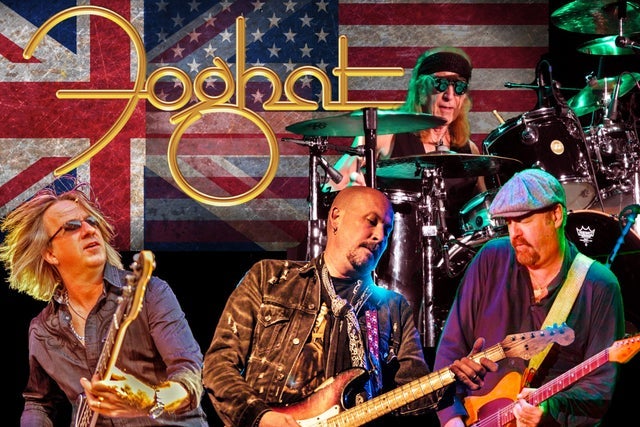
Foghat Tickets
You're in the loop for Foghat! We'll email you before tickets go on sale in your area.
Have more than just one favorite artist? Let My Ticketmaster keep track of all of them for you.
Has your taste changed? Use My Ticketmaster to find some new favorites!
Add to Favorites
End of Add to Favorites simulated dialog content.
Foghat Tickets and Concert Dates
|
|
Biography
In-depth Biography
Foghat specialized in a simple, hard-rocking blues-rock, releasing a series of best-selling albums in the mid-'70s. While the group never deviated from their basic boogie, they retained a large audience until 1978, selling out concerts across America and earning several gold or platinum albums. Once punk and disco came along, the band's audience dipped dramatically.
With its straight-ahead, three-chord romps, the band's sound was American in origin, yet the members were all natives of England. Guitarist/vocalist "Lonesome" Dave Peverett, bassist Tony Stevens, and drummer Roger Earl were members of the British blues band Savoy Brown, who all left the group in the early '70s. Upon their departure, they formed Foghat with guitarist Rod Price. Foghat moved to the United States, signing a record contract with Bearsville Records, a new label run by Albert Grossman. Their first album, Foghat, was released in the summer of 1972 and it became an album rock hit; a cover of Willie Dixon's "I Just Want to Make Love to You" even made it to the lower regions of the singles charts. For their next album, the group didn't change their formula at all -- in fact, they didn't even change the title of the album. Like the first record, the second was called Foghat; it was distinguished by a picture of a rock and a roll on the front cover. Foghat's second album was their first gold record, and it established them as a popular arena rock act. Their next six albums -- Energized (1974), Rock and Roll Outlaws (1974), Fool for the City (1975), Night Shift (1976), Foghat Live (1977), Stone Blue (1978) -- all were best-sellers and all went at least gold. "Slow Ride," taken from Fool for the City, was their biggest single, peaking at number 20. Foghat Live was their biggest album, selling over two million copies. After 1975, the band went through a series of bass players; Price left the band in 1981 and was replaced by Erik Cartwright.
In the early '80s, Foghat's commercial fortunes declined rapidly, with their last album, 1983's Zig-Zag Walk, barely making the album charts. The group broke up shortly afterward with Peverett retiring from the road. The remaining members of the band (Roger Earl, Erik Cartwright and Craig MacGregor) continued playing together as the Kneetremblers and after some line-up changes decided to revert to the Foghat name. The band toured throughout the decade and into the early 1990's. Perhaps growing tired of early retirement, Lonesome Dave formed his own version of Foghat in 1990 and hit the road. After healing their rift, the original Foghat (Peverett,Price, Stevens and Earl) reformed in 1993 and toured for years, releasing Return of the Boogie Men in 1994 and Road Cases in 1998. The original band broke apart for good with Peverett's passing due to cancer on February 7, 2000. After some time spent mourning, the band soldiered on with a new line-up (adding Charlie Huhn on vocals) and after two years of touring released Family Joules in 2002. Foghat toured for the next few years and regularly issued documents of their live act: The Official Bootleg DVD, Volume 1 in 2004 and Foghat Live II in 2007. ~ Stephen Thomas Erlewine and Tim Sendra, Rovi
See LessFriends on Ticketmaster
| Friend Images | Friend Status |
|---|
| Friend Images | Friend Status |
|---|