Short Biography
The Kaiser Chiefs--the band from Leeds whose acclaimed 2005 debut album Employment delivered one infectious hit after another ("I Predict a Riot," "Oh My God," "Everyday I Love You Less and Less," "Modern Way")--are back with a world tour and soon-to-be-released new album. The much anticipated Yours Truly, Angry Mob drops in late February 2007. Guitarist Andrew "Whitey" White recently spoke to Ticketmaster about the new album, playing live, and his most memorable concert experience.
TM: Give us a clue as to what to expect from the new album. Do you feel you've broken new ground, style-wise?
Andrew "Whitey" White: I don't think we've broken new ground. I think it's basically how we wanted to evolve from our first album Employment. I think we wanted it to be a natural evolution, so it's basically a bigger, better—hopefully—louder, stronger, faster record than before. I mean, we've grown up a lot the last couple of years from touring—just from experiencing different parts of the world. So I think that's reflected in the songs, really.
TM: Tell us about the record's name—Yours Truly, Angry Mob. Is this, in any way, a commentary on the fame brought to you by the first album?
AW: We've got a song on the album called "Angry Mob," so it's related to that directly. The song "Angry Mob" came before the title Yours Truly, Angry Mob. And, yeah, that's basically what the album's about. We're commentating on society basically. We're just observing. Especially recently in the UK, there's kind of a tabloid mentality to most of the press and the public seems to fall for it every time. I'm not saying that the tabloids are out to get anyone, but they have a lot of sway. I mean, they've got more say in how society is run than the politicians. Especially in England. It's kind of like shock tactics. (They'll write about) Terrorism, or the bird flu. There was a big bird flu thing in England. It never actually happened, but you know, everyone was scared.
TM: Whatever sells issues for them.
AW: Yeah.
TM: Your breakthrough song "I Predict a Riot" has, to me, probably one of the strongest pop hooks of recent memory. Did you have an inkling when writing it that it would become such a huge hit?
AW: Well, hindsight, of course, is a great thing! We knew that it was a great song, obviously, because we chose it as the single, but we didn't have the faintest idea that it was going to turn out like this. I mean, especially in England and Europe and the cool parts of America, as I call them.
TM: What are the cool parts of America?
AW: Well, the ones that I've been to. (laughs) I haven't been to all of America, but the places I've been to. Yeah, the song has turned into this big anthem and stuff. It's great. In England it's taken on...it's kind of part of English culture now, the saying or the phrase...So, it's great, yeah.
TM: How does the band go about writing songs? Is there a typical process you follow?
 AW: Yeah, but it's not like a formula or anything. Nick, the drummer, he kind of formed the band. It's his band really—he got us all together originally—so he comes up with ideas. He'll come into band practice and he'll be humming a song. He'll give us his idea and basically we'll shoot ideas off each other and turn it into a song really...Ricky works on lyrics a lot, but he never really comes in with a complete song. He never comes in and says play this and play that. He comes in and says "I've got this, what do you think?" That kind of thing. But Nick's the ideas man, definitely.
TM: And how did producer Stephen Street (The Smiths, Morrissey, The Cranberries, Blur) come on board?
AW: Well he did half of the first album and a guy called Steve Harris did the second half. He's obviously got a great repertoire, he's worked with some massive bands. But we never really got the chance to know him that well for the first album because we were touring a lot. We were very busy. So on the first album, we'd go into the studio for three days and record something, then we'd go on tour for two weeks. But this time we had a chance to...we had a big two month gap to record, so we got to know him a lot better and stuff. So we felt that especially from the first album, we had a lot more to do with Stephen Street--that our work wasn't finished with him. So we went with him.
TM: And you feel that it's a good "marriage"?
AW: Yeah. He gets us. He knows exactly what we're after. It's real easy to work with him.
TM: So after spending the past couple months working on the album, it must be exciting to play your new material to your fans. What's the response been so far to the new songs?
AW: It's been great so far. We recorded the album then we did a few gigs in Europe. Then we had the Christmas period off. And now in the new year, the album has gone to press and people have started talking about us again because we kind of disappeared for a year. It's great. It's really exciting. It's good to play the new songs in front of fans because you kind of gauge how well they go down, do you know what I mean? So it's great if the crowd go mental. If it's the first time they've heard a song and they're going crazy at the end of it—that's obviously a great sign.
Â
TM: What are some of the songs that people seem to like at first listen?
AW: "Angry Mob." People seem to really love "Angry Mob." "Ruby," "Heat Dies Down," "Highroyds," "Everything is Average." You know, I think those are the main ones we've been playing and they really seem to love them.
TM: Do you, personally, have any favorite songs that you like to perform live?
AW: All equally to be honest. We've got a new song on the album, "Retirement." It's the last song on the album and it's the last song we play in the set. I really like that song.
TM: And would that be a play-off of Employment?
AW: Yeah, kind of. And we jokingly said that our second album was going to be our last album and we were going to call it "Retirement." But, obviously, we never did. But we named a song after it anyway, and that's one of my favorites.
TM: I took a look at your tour schedule and I see that you're a band that likes to play lots of festivals, worldwide. How does playing a large festival compare to playing a single headliner gig?
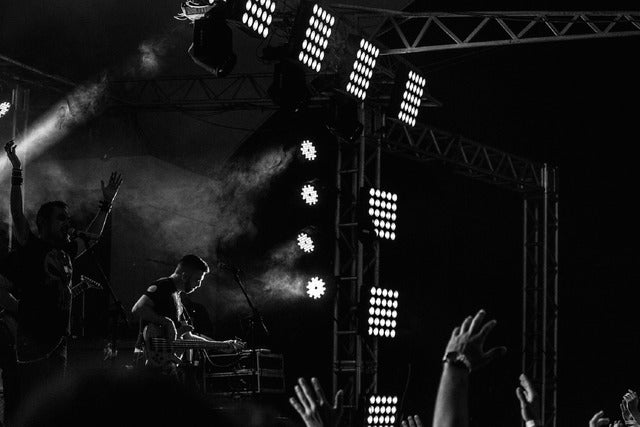
AW: Well, they're both just as good, but obviously vastly different. I mean, a gig you play to a thousand to maybe five thousand people. It's quite intimate. If it's your own headline gig then people are there to see you. At festivals people are just there to experience music. Maybe half the crowd, maybe even more than half the crowd has never even heard of you. Festivals are a good thing. It's a good way to play in front of a lot of people at once--a lot of people who have never seen you. So we like doing festivals because it's an opportunity to kind of grab as many fans as possible, so we play as hard as we can and as good as we can at festivals.
TM: Do you find that you prefer one over the other?
AW: No, not really. Festivals are usually more relaxed. You turn up at 12, you play for an hour, you get great food, you get to see other bands. So for the full day--then festivals. But for the actual gig experience, they're both just as good.
TM: For fans who've never seen you perform live, how would you describe your shows?
AW: I've never seen us live, so I don't know! (Laughs) We give our everything. We try and make it as enjoyable as possible for the people who've come there. Obviously they've paid good money to go there so they want to be entertained in some way, shape or form. So we just try our hardest so that people go home having seen a band giving it everything.
TM: And what's the most amazing live performance you've ever attended and why was it so memorable?
AW: It was Glastonbury 2004. It was my first ever Glastonbury. I'd been a massive festival goer before the band took off. I used to go to the Reading Festival in England a lot and I always said that the only time I'd go to Glastonbury was when I played (there) in a band. It never happened, you know, we played there the year after (laughs). But 2004 was my first Glastonbury and it was Paul McCartney headlining. And I'm an absolute Beatles nut and I'm a massive fan of Paul McCartney and just to see him playing "Blackbird" or "Back in the U.S.S.R."--it was amazing. It was the best gig I've ever seen. And it was a 60-year-old bloke!
In-depth Biography
When Tears for Fears sang, "Kick out the Style/Bring back the Jam," in "Sowing the Seeds of Love," one can imagine the lads in Kaiser Chiefs raising their mugs of ale in agreement. Comprised of vocalist Ricky Wilson, guitarist Andrew White, bassist Simon Rix, keyboardist Nick Baines, and drummer Nick Hodgson, Kaiser Chiefs resurrected the mod spirit of the Jam in "I Predict a Riot," supercharged class of '77 power pop that quickly electrified the British press when it was released in 2004. The song was inspired by Wilson's days as a club DJ in Leeds, England, where the group was also formed. The single and Kaiser Chiefs' pogo-inducing, boot-stomping live performances had them pegged as rising stars in the neo-new wave revolution with Franz Ferdinand, Dogs Die in Hot Cars, and the Futureheads. When Kaiser Chiefs' first 7" "Oh My God" reached Number 66 on the U.K. charts -- a startling achievement for an unsigned band -- doors opened for the group to share the stage with larger acts, consequently grabbing the attention of A&R scouts who wanted to sign them "I Predict a Riot," on the other hand, reeled in U.S. modern rock radio programmers caught in a blooming new wave revival. Without an American label deal, Kaiser Chiefs (named after the South African football team) crash-landed on some of the biggest U.S. alternative stations with the "I Predict a Riot" import single in late 2004. That same year they recorded their debut album Employment for the U.K. label B-Unique. The album was released domestically in the U.S. in spring 2005. The group's follow-up, Yours Truly, Angry Mob arrived in the Spring of 2007. ~ Michael Sutton, All Music Guide
See Less