We currently do not have any tickets on-sale for GenesisGet notified before Genesis tickets go on sale! Click the Add to My Alerts button above.Browse for an upcoming event:Download Music From iTunes
By clicking any links above, the iTunes application will launch or you will be prompted to download iTunes if you don't have it.
Biography for Genesis
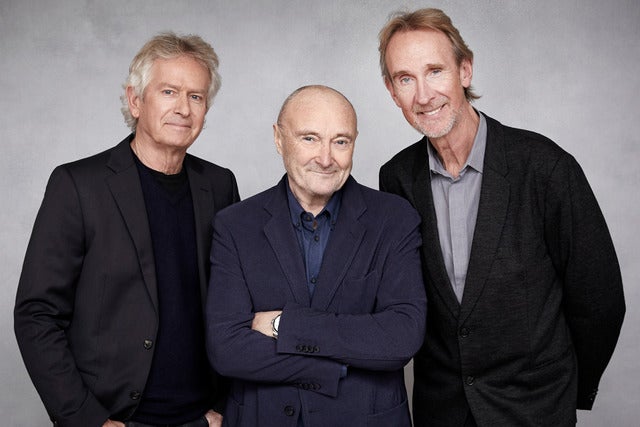
Genesis is a member of a small elite of British bands that have not only achieved massive international success but have sustained this over four decades. The news that the band's most successful line-up of Tony Banks, Phil Collins and Mike Rutherford were reforming after a break of 15 years for a European tour, was seized on by both fans and media alike.
Genesis have a sort of Midas Touch: the band released a series of groundbreaking albums in the seventies, became superstars in the eighties, survived the departures of not one but two lead vocalists/members at a crucial stage in their career, and have inspired tribute bands dedicated to just about every album in their superlative catalogue. They have sold over 130 million albums worldwide, played 1400 shows, including some of the most ambitious and theatrical performances ever staged, and gone from bottom of the bill with their Charisma label mates Lindisfarne and Van Der Graaf Generator in 1971 to headlining four consecutive sell-out dates at Wembley Stadium in 1987 playing to 288,000 people in total They have topped the charts around the world with albums as diverse as Duke, Abacab, Genesis, Invisible Touch and We Can't Dance and they remain a staple at radio across Europe, the US, Canada and beyond with tracks like ‘I Know What I Like', ‘Follow You, Follow Me', ‘Mama', ‘That's All', ‘In Too Deep', ‘Land Of Confusion', ‘Tonight, Tonight, Tonight' and ‘Throwing It All Away'. They have influenced bands as diverse as Simple Minds, Marillion, It Bites, the Flaming Lips, Elbow, The Feeling and Captain. In fact, over thirty years before Pete Doherty sang about ‘Albion', Genesis took their Lewis Carroll/Alice In Wonderland infused vision of Britain around the world with albums like Nursery Cryme, Foxtrot and Selling England By The Pound. Now, following a fifteen-year hiatus, the classic line-up of core members Tony Banks, Phil Collins and Mike Rutherford is reuniting for Turn It On Again - The Tour, a series of European concerts, in 2007. The trio will perform material from their classic albums and reconnect with their huge fan-base who have been speculating about this eagerly-awaited reunion every time the musicians have given interviews to promote the critically-acclaimed box-sets Genesis Archives, Vol 1: 1967-1975 and Genesis Archives, Vol. 2: 1976-1992 and the best-selling compilations Turn It On Again - The Hits and The Platinum Collection. It all started in the mid-sixties at Charterhouse, an English public school whose most famous alumnus was composer Ralph Vaughan Williams. Vocalist and flautist Peter Gabriel, keyboard-player Tony Banks and drummer Chris Stewart played in a band called The Garden Wall while guitarists Anthony Phillips and Mike Rutherford were members of Anon. After playing a school concert together in 1966, they joined forces as Genesis and released their debut single, ‘The Silent Sun', on Decca, at the beginning of 1968. By the time the group belatedly made their live debut in September 1969, their first album, From Genesis To Revelation, had sold a paltry 650 copies but, having passed their A-levels, the budding songwriters decided to give music a go. John Mayhew replaced Stewart behind the drum kit and they signed to Tony Stratton-Smith's Charisma label in March 1970 and issued the Trespass album - with early fan favourite ‘The Knife' - in October that year. 1971 saw the arrival of drummer Phil Collins and guitarist Steve Hackett, both recruited via ads in Melody Maker, who helped the group's vision coalesce on Nursery Cryme, in particular on ‘The Musical Box', the album's opening track. This line-up built a big cult following around the UK, made the first of many forays into continental Europe and began making a name for itself in Belgium, Italy and France. When Foxtrot - complete with tour de force suite ‘Supper's Ready' - came out in October 1972, it made the albums chart in Britain. Gabriel became rock's premier frontman, telling whimsical stories and sporting a variety of masks and costumes, while the band made short shrift of the technical limitations of the day. Genesis Live, their first top ten album, further capitalized on their emerging popularity and worked even without the group's stunning visuals. Selling England By The Pound, issued at the tail end of 1973, gave them a well-deserved hit single with the quirky ‘I Know What I Like (In Your Wardrobe)' in 1974. The Lamb Lies Down On Broadway, an ambitious concept album, put a New York spin on Gabriel's story of the proto-punk Rael and led to one of their most visually-stunning live presentations. However, when the frontman left after a lengthy world tour in the middle of 1975, observers were quick to write the group off. Collins' subsequent emergence from behind the drum kit shouldn't have come as a surprise since he'd already been the featured vocalist on ‘More Fool Me' and had enjoyed success as a child actor. He stepped up to the plate and excelled on tracks like ‘Robbery, Assault And Battery and ‘Ripples', helping A Trick Of The Tail become the band's biggest-selling album to date in 1976. The drummer took centre stage, developed a completely different stage persona to his predecessor, and endeared himself to long-standing Genesis fans while engaging a whole new generation, especially in the US. Following the delicate, pastoral Wind And Wuthering and the Spot The Pigeon EP - whose lead track ‘Match Of The Day' made the Top 20 in 1977 - Hackett left too but Banks, Collins and Rutherford continued and again defied the doubting jeremiahs. Their first album as a trio, . . . And Then There Were Three . . . went gold in the US in 1978 and they scored their first Top Ten single in Britain with the melancholy ballad ‘Follow You, Follow Me' right in the middle of the punk era, while many of their contemporaries fell by the wayside. Against all predictions, Genesis became bigger still in the eighties. The Duke album topped the UK album charts in 1980 while the irresistible ‘Turn It On Again' blared out of radios around the world. Banks, Collins and Rutherford pared down their songwriting to its melodic core and simpler, gentler, more tender songs like ‘Misunderstanding' hit a nerve with the mainstream. Abacab and its infectious title track built around a chord sequence jam at their Surrey studio, triumphed at the end of 1981. This looser, more informal approach worked a treat again on Genesis, their 1983 album, and the atmospheric ‘Mama' in particular. By 1986, all three members had released successful solo albums and had further enhanced their profile. Invisible Touch spawned five worldwide hits - the title track, ‘In Too Deep', ‘Land Of Confusion', ‘Tonight, Tonight, Tonight' and ‘Throwing It All Away' - as Genesis headlined stadiums and their videos became a staple of MTV. In 1991, Banks, Collins and Rutherford repeated this unbelievable feat with We Can't Dance, another UK number one album containing five, yes five, hit singles - ‘ No Son Of Mine', ‘I Can't Dance', ‘Hold On My heart', ‘Jesus He Knows Me' and ‘Tell Me Why' - and bowed out after the lengthy world tour which followed throughout 1992. Four years later, Collins announced he was leaving the group. Banks and Rutherford recorded one more Genesis album, Calling All Stations, and toured with Stiltskin vocalist Ray Wilson in 1998 before taking a well-deserved break despite the album selling over 1million copies. With Banks, Collins and Rutherford now reunited, the most successful incarnation of Genesis is together again, ready, as the song says, to Turn It On Again. www.genesis-music.com Genesis Short Biography
Genesis is a member of a small elite of British bands that have not only achieved massive international success but have sustained this over four decades. The news that the band's most successful line-up of Tony Banks, Phil Collins and Mike Rutherford were reforming after a break of 15 years for a European tour, was seized on by both fans and media alike. Genesis have a sort of Midas Touch: the band released a series of groundbreaking albums in the seventies, became superstars in the eighties, survived the departures of not one but two lead vocalists/members at a crucial stage in their career, and have inspired tribute bands dedicated to just about every album in their superlative catalogue. They have sold over 130 million albums worldwide, played 1400 shows, including some of the most ambitious and theatrical performances ever staged, and gone from bottom of the bill with their Charisma label mates Lindisfarne and Van Der Graaf Generator in 1971 to headlining four consecutive sell-out dates at Wembley Stadium in 1987 playing to 288,000 people in total They have topped the charts around the world with albums as diverse as Duke, Abacab, Genesis, Invisible Touch and We Can't Dance and they remain a staple at radio across Europe, the US, Canada and beyond with tracks like ‘I Know What I Like', ‘Follow You, Follow Me', ‘Mama', ‘That's All', ‘In Too Deep', ‘Land Of Confusion', ‘Tonight, Tonight, Tonight' and ‘Throwing It All Away'. They have influenced bands as diverse as Simple Minds, Marillion, It Bites, the Flaming Lips, Elbow, The Feeling and Captain. In fact, over thirty years before Pete Doherty sang about ‘Albion', Genesis took their Lewis Carroll/Alice In Wonderland infused vision of Britain around the world with albums like Nursery Cryme, Foxtrot and Selling England By The Pound. Now, following a fifteen-year hiatus, the classic line-up of core members Tony Banks, Phil Collins and Mike Rutherford is reuniting for Turn It On Again - The Tour, a series of European concerts, in 2007. The trio will perform material from their classic albums and reconnect with their huge fan-base who have been speculating about this eagerly-awaited reunion every time the musicians have given interviews to promote the critically-acclaimed box-sets Genesis Archives, Vol 1: 1967-1975 and Genesis Archives, Vol. 2: 1976-1992 and the best-selling compilations Turn It On Again - The Hits and The Platinum Collection. It all started in the mid-sixties at Charterhouse, an English public school whose most famous alumnus was composer Ralph Vaughan Williams. Vocalist and flautist Peter Gabriel, keyboard-player Tony Banks and drummer Chris Stewart played in a band called The Garden Wall while guitarists Anthony Phillips and Mike Rutherford were members of Anon. After playing a school concert together in 1966, they joined forces as Genesis and released their debut single, ‘The Silent Sun', on Decca, at the beginning of 1968. By the time the group belatedly made their live debut in September 1969, their first album, From Genesis To Revelation, had sold a paltry 650 copies but, having passed their A-levels, the budding songwriters decided to give music a go. John Mayhew replaced Stewart behind the drum kit and they signed to Tony Stratton-Smith's Charisma label in March 1970 and issued the Trespass album - with early fan favourite ‘The Knife' - in October that year. 1971 saw the arrival of drummer Phil Collins and guitarist Steve Hackett, both recruited via ads in Melody Maker, who helped the group's vision coalesce on Nursery Cryme, in particular on ‘The Musical Box', the album's opening track. This line-up built a big cult following around the UK, made the first of many forays into continental Europe and began making a name for itself in Belgium, Italy and France. When Foxtrot - complete with tour de force suite ‘Supper's Ready' - came out in October 1972, it made the albums chart in Britain. Gabriel became rock's premier frontman, telling whimsical stories and sporting a variety of masks and costumes, while the band made short shrift of the technical limitations of the day. Genesis Live, their first top ten album, further capitalized on their emerging popularity and worked even without the group's stunning visuals. Selling England By The Pound, issued at the tail end of 1973, gave them a well-deserved hit single with the quirky ‘I Know What I Like (In Your Wardrobe)' in 1974. The Lamb Lies Down On Broadway, an ambitious concept album, put a New York spin on Gabriel's story of the proto-punk Rael and led to one of their most visually-stunning live presentations. However, when the frontman left after a lengthy world tour in the middle of 1975, observers were quick to write the group off. Collins' subsequent emergence from behind the drum kit shouldn't have come as a surprise since he'd already been the featured vocalist on ‘More Fool Me' and had enjoyed success as a child actor. He stepped up to the plate and excelled on tracks like ‘Robbery, Assault And Battery and ‘Ripples', helping A Trick Of The Tail become the band's biggest-selling album to date in 1976. The drummer took centre stage, developed a completely different stage persona to his predecessor, and endeared himself to long-standing Genesis fans while engaging a whole new generation, especially in the US. Following the delicate, pastoral Wind And Wuthering and the Spot The Pigeon EP - whose lead track ‘Match Of The Day' made the Top 20 in 1977 - Hackett left too but Banks, Collins and Rutherford continued and again defied the doubting jeremiahs. Their first album as a trio, . . . And Then There Were Three . . . went gold in the US in 1978 and they scored their first Top Ten single in Britain with the melancholy ballad ‘Follow You, Follow Me' right in the middle of the punk era, while many of their contemporaries fell by the wayside. Against all predictions, Genesis became bigger still in the eighties. The Duke album topped the UK album charts in 1980 while the irresistible ‘Turn It On Again' blared out of radios around the world. Banks, Collins and Rutherford pared down their songwriting to its melodic core and simpler, gentler, more tender songs like ‘Misunderstanding' hit a nerve with the mainstream. Abacab and its infectious title track built around a chord sequence jam at their Surrey studio, triumphed at the end of 1981. This looser, more informal approach worked a treat again on Genesis, their 1983 album, and the atmospheric ‘Mama' in particular. By 1986, all three members had released successful solo albums and had further enhanced their profile. Invisible Touch spawned five worldwide hits - the title track, ‘In Too Deep', ‘Land Of Confusion', ‘Tonight, Tonight, Tonight' and ‘Throwing It All Away' - as Genesis headlined stadiums and their videos became a staple of MTV. In 1991, Banks, Collins and Rutherford repeated this unbelievable feat with We Can't Dance, another UK number one album containing five, yes five, hit singles - ‘ No Son Of Mine', ‘I Can't Dance', ‘Hold On My heart', ‘Jesus He Knows Me' and ‘Tell Me Why' - and bowed out after the lengthy world tour which followed throughout 1992. Four years later, Collins announced he was leaving the group. Banks and Rutherford recorded one more Genesis album, Calling All Stations, and toured with Stiltskin vocalist Ray Wilson in 1998 before taking a well-deserved break despite the album selling over 1million copies. With Banks, Collins and Rutherford now reunited, the most successful incarnation of Genesis is together again, ready, as the song says, to Turn It On Again. www.genesis-music.com Genesis In-depth Biography
One of the most successful rock acts of the 1970s, 1980s, and 1990s, Genesis enjoyed a longevity exceeded only by the likes of the Rolling Stones and the Kinks, in the process providing a launching pad for the superstardom of members Peter Gabriel and Phil Collins. The group had its roots in the Garden Wall, a band founded by 15 year olds Peter Gabriel and Tony Banks in 1965 at Charterhouse School in Godalming, Surrey, where fellow students Michael Rutherford and Anthony Phillips were members of another group called Anon. The two groups initially merged out of expediency as the older members of each graduated; Gabriel, Banks, Rutherford, Phillips, and drummer Chris Stewart soon joined together as the New Anon, and recorded a six-song demo featuring songs primarily written by Rutherford and Phillips.
The Charterhouse connection worked in their favor when ex-student, recording artist, and producer Jonathan King heard the tape and arranged for the group to continue working in the studio, developing their sound. It was also King who renamed the band Genesis. In December of 1967 the group had its first formal recording sessions. Their debut single, "The Silent Sun," was released in February of 1968 without attracting much notice from the public. A second single, "A Winter's Tale," followed just about the time that Chris Stewart quit -- his replacement, John Silver, joined just in time to participate in the group's first LP sessions that summer. King later added orchestral accompaniment to the band's tracks, in order to make them sound even more like the Moody Blues, and the resulting album, entitled From Genesis to Revelation, was released in March of 1969. Music seemed to be shaping up as a brief digression in the lives of the members as they graduated from Charterhouse that summer. The group felt strongly enough about their work, however, that they decided to try it as a professional band; it was around this time that Silver exited, replaced by John Mayhew. They got their first paying gig in September of 1969, and spent the next several months working out new material. Genesis soon became one of the first groups signed to the fledgling Charisma label, and they recorded their second album, Trespass, that spring. Following its completion, the unit went through major personnel changes as Phillips, who had developed crippling stage fright, was forced to leave the lineup in July of 1970, followed by Mayhew. Enter Phil Collins, a onetime child actor turned drummer and former member of Hickory and Flaming Youth. The group's lineup was completed with the addition of guitarist Steve Hackett, a former member of Quiet World; his presence and that of Collins toughened up the group's sound, which became apparent immediately upon the release of their next album, Nursery Cryme. The theatrical attributes of Gabriel's singing fit in well with the group's live performances during this period as he began to make ever more extensive use of masks, makeup, and props in concert, telling framing stories in order to set up their increasingly complicated songs. When presented amid the group's very strong playing, this aspect of Gabriel's work turned Genesis' performances into multimedia events. Foxtrot, issued in the fall of 1972, was the flash point in Genesis' history, and not just on commercial terms. The writing, especially on "Supper's Ready," was as sophisticated as anything in progressive rock, and the lyrics were complex, serious, and clever, a far cry from the usual overblown words attached to most prog rock. Genesis' live performances by now were practically legend, and in response to the demand, in August of 1973 Charisma released Genesis Live, an album assembled from shows in Leicester and Manchester originally taped for an American radio broadcast. 1973 also saw the release of Selling England by the Pound, the group's most sophisticated album to date. The release of the ambitious double LP The Lamb Lies Down on Broadway in late 1974 marked the culmination of the group's early history; in May of 1975, following a show in France, Gabriel announced that he was leaving Genesis, owing to personal reasons. The group tried auditioning potential replacements, but it became clear that the remaining members all preferred that drummer Collins take over the role of lead singer. The band returned to the studio as an official quartet in October of 1975 to begin work on their new album: the resulting Trick of the Tail made number three in England and number 31 in America, the best chart showing up to that time for a Genesis album. Its success completely confounded critics and fans who'd been unable to conceive of Genesis without Peter Gabriel. The group seemed to be on its way to bigger success than it ever had during Gabriel's tenure, as 1977's Wind and Wuthering became another smash. But then Hackett announced that he was leaving on the eve of the release of a new double live album, Seconds Out; he was replaced on the subsequent American and European tours by Daryl Steurmor, but there was no permanent replacement in the studio. In 1978, Genesis released And Then There Were Three, which abandoned any efforts at progressive rock in favor of a softer, much more accessible, and less ambitious pop sound. After a flurry of solo projects, the group reconvened for 1980's Duke, which became their first chart-topper in England while rising to number 11 in America. The continued changes in their sound helped turn Genesis into an arena-scale act: Abacab, released in late 1981, was another smash, and 1983's self-titled Genesis furthered the group's record of British chart-toppers and American Top Ten hits, becoming their second million-selling U.S. album while also yielding their first American Top Ten single, "That's All." Two years later, the group outdid themselves with the release of their most commercially successful album to date, Invisible Touch, which went platinum several times over in America. Its release coincided with the biggest tour in their history, a string of sold-out arena shows that cast the group in the same league as concert stalwarts like the Rolling Stones and the Grateful Dead. Their 1991 album We Can't Dance debuted at number one in England and got to number four in America; it was Collins' last album with the group, and with new vocalist Ray Wilson, formerly of the group Stiltskin, Genesis resurfaced in 1997 with Calling All Stations, which recalled their art rock roots. Neither the critics nor the fans warmed to the album -- it sold poorly and the tour was equally unsuccessful. Coming on the heels of the disappointing Calling All Stations, the long-awaited box-set retrospective Genesis Archives, Vol. 1: 1967-1975 was even more welcome. Containing nothing but unreleased material and rarities from previously unavailable on CD, the set was released to surprisingly strong reviews in the summer of 1998. A second volume, containing unreleased material from the Phil Collins era, Genesis Archives, Vol. 2: 1976-1992, followed in 2000. ~ Bruce Eder, All Music Guide Some of the information on this page is provided by All Music Guide and does not necessarily reflect the views of Ticketmaster.
|
|||||||||