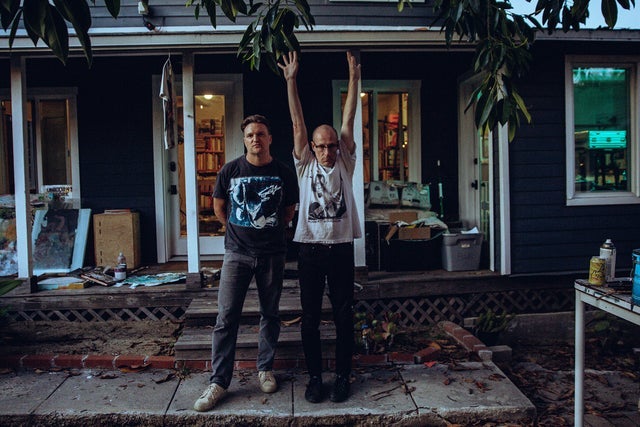
If Nathan Willett followed his usual impulses, Cold War Kids' 10th album might just have been a five-song EP, or an album with entirely different songs than the 12 ultimately chosen here. Instead, Willett took a rare pandemic-era breather to really contemplate what a Cold War Kids album could, and should, sound like in 2023, and how to infuse the material with meaningful discourse about his life specifically and the state of the world more broadly. Clearly, it was worth the wait: the aptly self-titled result is perhaps the strongest and most well-rounded full-length in the long-running California band's ample catalog, and the purest possible distillation of Cold War Kids' nearly 20-year career.
Over the course of nine studio albums and numerous EPs, Cold War Kids have become a major part of the modern musical landscape thanks to deeply personal songcraft and a commitment to forward motion. "First," their platinum-selling 2015 single, named as the most played track at alternative radio outlets nationwide in the last decade, and 2007's "Hang Me Up To Dry" remaining a festival staple. Their current lineup - Willett (vocals, piano, guitar), Matt Maust (bass guitar), David Quon (guitar, backing vocals), Matthew Schwartz (keyboards, backing vocals, guitar, percussion), and Joe Plummer (drums, percussion) - coalesced in 2016 and has released a whopping four albums and five EPs since then.
"If I've got five songs done that I've worked on in a certain way, I tend to want to put them out as an EP and go do some shows around it," Willett says of his mindset during the early stages of Cold War Kids. "Continually as my brain would go to that place, I'd go, no, just wait, and really put together a full-length record. I needed to approach things very differently and work with some new people in a way that was a little uncomfortable. This album is where I've most felt like I was the executive producer of everything."
At first, Willett thought initial work with producer Carlos de la Garza (Paramore, M83) could be grist for another quick EP. Eventually, he realized one song in particular from those sessions, "Run Away With Me," was leading him down a different path. With its funky groove and huge chorus, "Run Away With Me" set the tone for what was to come on Cold War Kids: 12 high-minded, stylistically diverse songs referencing everything from Sly and the Family Stone and Curtis Mayfield to the Pretenders and Elton John to Happy Mondays and Gang Of Four.
"The band started out with four guys who have very specific tastes and styles, and now it's mostly me making the records in a way I love and have always envisioned," Willett says. "The sound of Cold War Kids has always been there, and I wanted this record to be the ideal, best version of all those things we've always been."
Just as the music on Cold War Kids draws equally from the band's blues-and-soul-driven sonic past as well as fresh forays into dance beats and '80s pop/rock, the album's themes of creative life conflicting with domestic realities reflect Willett's increasingly introspective state of mind. There are songs about breaking up with a trusted therapist ("Another Name"), juggling gender norms ("Double Life") and reckoning with a toxic past ("Toxic Masculinity"), the desire to escape stability ("Stray"), and the beauty of surrender and weakness ("Blame").
Committed to pushing himself just as hard to create the album's sound, Willett turned to a handful of new producers and collaborators, including Militarie Gun's Max Epstein,Casey Lagos (Kesha, Wrabel), Ethan Gruska (Phoebe Bridgers, Weezer), Jenn Decliveo (Miley Cyrus, Hozier), and Malay (Frank Ocean, Lorde).
"Like most people, I spent a lot of time at home during the pandemic with my kids, in many ways for the first time," Willett says. "While my partner was working, I became the mother. I had to shed my identity as a musician and an artist and could no longer play the role of best supportive male provider. I wanted to channel all this struggle and soul-searching, because it gave me a window of insight and access to the feminine experience that I needed to grow and ultimately create this album."
Willett singles out the slow-burning, piano-dominated "Another Name" as a turning point. On the day he was scheduled to work with Gruska for the first time, he'd also had his final session with his longtime therapist. "I started telling Ethan about it, which could have been really awkward with someone I'd never met. It's not easy to walk into a room and just write a song with a stranger," he says. "But instead, it was totally natural. The song came out almost fully formed, and it was probably the single best experience I've ever had working with a producer."
As much as Willett is probing his own psyche on Cold War Kids, he's also taking stock of how he interacts with the people around him. On the surface, the Malay-produced "For Your Love" is a universal song about a universal emotion, but in it Willett finds deeper meaning in holding his crying baby daughter in the middle of the night. Elsewhere, "Betting on Us" is both "a relationship song and a self-reflection song, but it's also about being an artist. It's so much easier to be driven by wanting to play your music and show it to people, and so much harder to have to slow down and say, what is the reason for any of this? What do I hope that this does? Do I want success for its own sake, and if so, I need to not (laughs). I already have so much!"
This conundrum resurfaces in album closer "Starring Role," which was inspired by an epiphany Willett had while idly looking at celebrity gossip on his phone while waiting to pick up a rental car. "On one level, Cold War Kids, and the success we've had, is an absolute miracle beyond anything I would have hoped," he says. "On another level, like anybody, I see wrong moves we made or tours we should have taken or opportunities we blew, and I'm like, aaah! I think there's more mountains for us to climb. You have to be honest and at the same time a little crazy to be like, I want more, but I don't want to be narcissistic or greedy."
Ultimately, Cold War Kids is the culmination of Willett and Maust's two-decade creative partnership, and it embodies the realization that said partnership is still truly worth celebrating. "For so many years, we were white-knuckling it and feeling like we were imposters," Willett admits. "I realized, I can't think that way. If I'm not sure I can listen back to something and know that it's great, then I shouldn't be putting it out."
"This group of friends met and were drawn to each other at a Christian college, and we started the band in a strange environment where we realized, what are we all doing here?," Willet says. "We came from a place of growing up, listening to music, and going to shows, and there's a type of sweetness where we were sheltered from the music industry or wanting to be successful at any cost. Maust and I still have that connection, and it's still an important part of what Cold War Kids are today."