
Awesome!
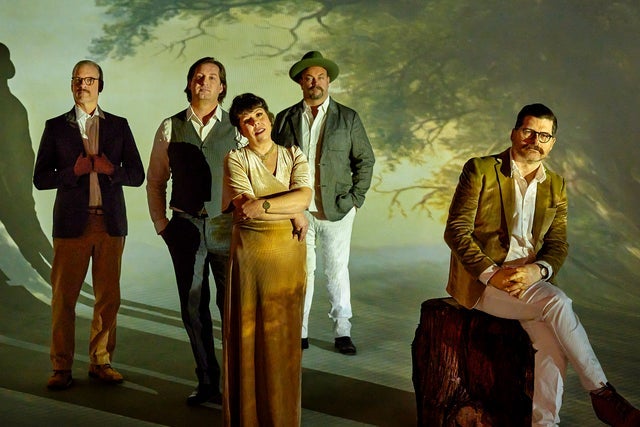
by mettyboy on 12/8/22The Wiltern - Los AngelesThe Decemberists were fantastic! Gave it their all and were brilliant! Fun and personable band.
Venue
Roadrunner-Boston
Lineup
Venue
College Street Music Hall
Venue
Stage AE
Add-Ons
Lineup
Venue
The Eastern-GA
Venue
Bass Concert Hall
Lineup
Venue
Venue
Riverside Theatre - WI
Venue
Palace Theatre-MN
Venue
Royal Oak Music Theatre
Lineup
Venue
Holliday Park
Lineup
Venue
Ryman Auditorium
Add-Ons
Lineup
An ancient Japanese folk tale, fanfare for a child monarch and a vengeful mariner in the belly of a whale are not typical subjects for your everyday pop/rock song—unless, of course, you are Colin Meloy, the hyper-literate frontman and songsmith for the acclaimed Portland, Oregon-based band The Decemberists. While other bands pen chart-topping hits about more readily-accessible themes like relationship woes, Meloy set the Decemberists apart early on by admittedly writing songs meant to "alienate" audiences. Despite this, their narrative lyrics and distinct, folk-tinged sound has found enormous favor—perhaps more so than the band ever expected—with audiences and critics alike. The Crane Wife marks their fourth full-length release, as well as their major label debut for Capitol Records. In this exclusive interview, Colin Meloy speaks with Ticketmaster about The Decemberists' latest musical explorations and their current US and European tour. Ticketmaster: What was it about The Crane Wife folk tale that inspired you enough to build an album around it?
Colin Meloy: Well, the whole album's not based around the Crane Wife, it's just those three songs—that cycle of songs. I guess in some ways, unintentionally, there should be some crossover a little bit... there should (be) an over-running theme. The story itself was really fascinating to me. For whatever reason, I thought it was a really beautiful story. It kind of had a quality to it that suggested that it was a story that wasn't really invented by a western imagination or a contemporary imagination. It felt really ancient in some way and that aspect attracted me as well.
TM: There are some musical styles on this record that I've not heard from the band before such as the prog-rock synths in "The Landlord's Daughter," (part 2 of "The Island") the—dare I say it—headbanging guitar riffs on "When the War Came" and "Come and See" and the disco-y "Perfect Crime 2." Did inspiration for these songs come lately, or have you been itching to explore these styles for a while?
CM: Yeah, I think that stuff has been percolating for a while. As far as exploring—definitely some of the more kind of ‘70s folk-prog stuff was in The Tain, our EP that came out a couple years ago. The Tain had been written after most of the material for Picaresque had been written, so that recording process, I think, informed this record more than it did Picaresque, the way things turned out. And the other stuff...really didn't feel unnatural, like I didn't really sit down and think "ok I need to write something particularly outside of our idiom." I don't think we've been too tethered at all by a single sound or a single type of music, so it felt within our grasp to do those other types of music.
TM: I read that you collect quite a bit of obscure music on vinyl and then that music will subsequently influence what you're currently writing. What were you listening to when you were writing and recording The Crane Wife?
CM: I was on a seriously steady diet of Anne Briggs who was a ‘50s and ‘60s folk revival person. She only recorded three records. Her last record wasn't even released until the late ‘90s but it was recorded in ‘72. But she didn't like the sound of her recorded voice even though it's gorgeous. So she just stopped recording and moved to some far-flung island in Scotland and lived there ever since. But those records are amazing, totally amazing and I was listening to those a lot.
TM: Now I'm going to ask a question for my Northern Irish friend, who asked me to ask you.
CM: (Sounding slightly apprehensive) Oh ok. Oh boy.
TM: Your song "Shankill Butchers" references (the true story of) some pretty horrific crimes committed in Northern Ireland in the ‘70s. How did you get the idea to turn such gruesome subject matter into a child's lullaby?
CM: Well because that's essentially, as far as I know, that's sort of what happened. The telling of that story that I read, it was actually in Johnny Rogan's biography of Van Morrison of all things in a section about The Troubles (of Northern Ireland). And I read a lot about The Troubles but I'd never seen any mention of the Shankill Butchers till then. And the crimes themselves are so horrific, with kind of fairy tale proportions, you know. There were these guys who insisted on using only meat cleavers and butcher's knives. And supposedly, parents would use it as a cautionary tale for their kids and would say "if you don't do what you're told, then the Shankill Butchers are gonna come and get you." So really, it's just kind of an honest retelling of that episode. And...we've actually had some emails from the relatives of victims who... object to the song. And the only response is we didn't try to sensationalize it or anything, it was just an honest retelling of the account that I read, and kind of showing how horrific it was and how nonsensical the crimes were.
TM: Well of course I'm not Northern Irish, but it seems to me a sensitive treatment (of the subject).
CM: Yeah, I would hope. I would hope. But we'll see what happens when we go over there. I don't know. We get differing accounts from people whether there truly is kind of an uproar or if it's a few people. But honestly, we didn't intend any offence whatsoever to relatives. None at all.
TM: Now correct me if I'm wrong. This album doesn't feel quite as lighthearted as your previous albums. Would you agree?
CM: Yeah, I think that's fair.
TM: Why the serious turn?
CM: I don't know, I guess it's just what was coming out at the time. Just a shift in my thinking. A shift in the writing. I don't know what to attribute it to. I guess it just felt like the material itself was coming out more in earnest and less with an ironic feel to it. I don't know why.
TM: Alright, I'm gonna change gears a bit and talk about your live show. You're in the middle of a tour right now. How's it going? Any interesting stories?
CM: It's been great so far. It's probably too soon to tell. All the good stories end up happening when you're more like halfway through and everyone starts going a little crazy. Right now, we're all staying relatively sane, though the inevitable tour cold seems to be making its rounds already. So that's not a good sign but whatever—it's inevitable.
TM: Where have you played so far?
CM: Portland, San Francisco, L.A., Tucson, and Austin. Tonight we're in Dallas.
TM: There's a lot of audience interaction at your shows. You've even played fun games with the audience between songs. Is it important for you to make the audience a part of the show?
CM: Yeah, I think so. All that stuff happens really spontaneously. I don't think I ever set out to be a band that uses a lot of audience interaction, you know. I feel like anything that you do on stage that doesn't involve just playing your music should be done spontaneously and should happen organically. It's nothing that should be deliberately decided on. So that sort of stuff just happens...I don't know. I guess it just occurs to me on stage that there's just all these people out there, just standing there, so I might as well sort of make friends with them, you know.
TM: You always have an eclectic mix of instruments with you on stage. Anything interesting you're bringing with you for the current tour?
CM: Yeah, we have a Hammond B3 organ . We've been waiting our whole careers to be able to take out a full-on Hammond B3, so that's been exciting. Chris Funk has his hurdy-gurdy which is always interesting trying to tune it. And then we have your normal range of things, you know, your banjos and your squareneck guitars and bouzoukis (long-necked stringed instruments) and things like that.
TM: Are there any specific cities or venues you always look forward to visiting on tour?
CM: San Francisco has always been fun for us. That was the first place that we ever played that felt like a second home, that we were actually drawing fans rather than just locals who happen to be at the bar. New York has always been great. And then there's always the fun little places like North Hampton, Massachusetts, which typically brings out a really good crowd. You know, I can't say that I don't like playing anywhere. They're all really great to play in.
TM: Do you have a favorite song to perform live?
CM: A font?
TM: Song (laughs). Do you have a favorite song that you like to perform live?
CM: Oh, I thought you said "font." (laughs) My favorite font is Caravan. Adobe actually makes a really nice Caravan. That's going to be the official Decemberists font. (laughs) My favorite song to play live? I've been enjoying playing "The Island," which is a song on the new record—a 12-minute, three-part song that's been really fun to play.
TM: What do you like about it? Is it the epic quality of it?
CM: Yeah. We just get an opportunity to rock out a little bit, which is fun.
TM: Do you feel more at home recording in the studio or out on the road performing for audiences?
CM: It really depends. Sometimes I really like playing live and other times I like sitting in the studio and parsing through parts, you know. It really just depends. Lately, I really liked being in the studio working on this record. It might be that I'm starting to like the studio more. But we'll see how this tour goes, I guess.
TM: You're out with the full band for this tour. I know you've also done some solo records and gone on the road solo as well. How would you compare playing with a band and playing on your own?
CM: Well, they're very different. I'm able to travel a lot lighter, obviously, playing solo. Also, there's a certain amount of freedom you have on stage playing solo...(When you're playing with a band) you don't want to talk too much, ‘cause other band members might want to keep moving. And you're not accountable to other people on stage. But then again when you're playing solo there's a certain loneliness there and you can't quite get the full arrangements of songs. So they both have their qualities that are fun.
TM: Do you have any plans for a future solo tour?
CM: Yeah, though I don't think that will be until next year. Probably winter of 2007 or early spring of 2008. I think we're going to be pretty busy with this record up until then.
The Decemberists were fantastic! Gave it their all and were brilliant! Fun and personable band.
The best live! This was a wonderful set list and they ended the 2022 tour on a high note!
The Decemberists are by far one of the best bands live. The lyrics are thought provoking and the musicians know how to entertain. Seen them twice and can’t wait to see them again.
The Decemberists are a fantastic band and their show was amazing, and the Tabernacle itself as a venue is stunning, the artwork is beautiful. However, live nation sucks. There is no reason people should have to pay $5 for a CAN of water. It’s almost like they want people to pass out at their shows. It’s not that difficult to have a water station with cups to the side of the bar for attendees to use. Also, $11 for a domestic beer is straight robbing people.
The show was great! Love the venue! Not a fan of the canned water. I'm all about reducing plastic use, but as someone that has been 2.5 years sober, some more water options would be nice. I know a lot of venues have igloo cooler stations. Sobriety is hard enough without having to drink tepid water from a can. We also help some the drunk ones get safely home, so how about a little love.
Decemberists were amazing. Tabernacle was miserable due to HVAC not working. It made for a sweaty evening for all. Even the artists complained because they had to keep changing out instruments. Probably not the best Covid environment, either.
The Decemberists put on an amazing performance, I have been wanting to see them for over a decade and they did not disappoint. And the Tabernacle is an amazing venue, one of my favorites in Atlanta. 10/10
This is my second time seeing the Decemberists and they were very good again. Fine musicians throughout the band especially Colin on vocals and Jenny on piano/keyboards and especially accordion (yes, accordion!). Fine job mixing, individual instruments could be heard, most importantly, Colin’s vocals. My only beef ( other than the tool sitting in front of me, acting like he was in a Decemberists ballet, acting out the music with his flailing arms) was once again, they didn’t play “Make You Better”, one of their best songs in my opinion. Go see them, you’ll be glad you did.
Between the venue and seeing the Decemberists insane set list, I had one of the best nights in my life
Fantastic show at this beautiful venue. Sound system was great.