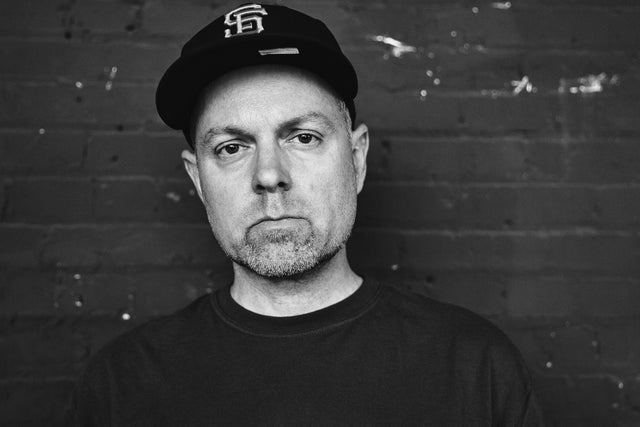
The
Outsider, the
latest album by instrumental hip-hop prodigy DJ Shadow,
hits stores in
September, and he's currently touring worldwide in support of the release. He
gives Ticketmaster the scoop on the new record, his live shows and the state of
hip-hop in 2006.
TM:
Let's talk about the new album The Outsider. Some have said that it
sounds like a collection of singles rather than a unified piece with an
overlying theme. Do you agree?
DJ Shadow: I don't
necessarily disagree. I just feel like any album is kind of a snapshot of where
an artist is at in that particular (in my case, two years) time-frame in their
career. So this album is no more or less than that really—which I think is the
same for any other album I've done. I guess what I tried to do is make a record
that was really representative of what I'm interested in in music, and
represents me well as far as what I like and what I'm about and what I stand
for musically. And then at that point it was just a matter of assembling it in
such a way that the songs were able to stand on their own, because I felt like
all the songs were really dense and just good songs in their own right and I
didn't want to load them up with a bunch of skits and interludes and
things just so people felt that it was more album-y. I also felt sort of
emboldened by the sort of feeling that things are changing in the way people
digest music. I feel like this is a sort of an iTunes mix tape world and...if
anything, I thought that people would appreciate that this album is a bit of an
anomaly in the market place because it's so diverse. And I also feel that the
whole concept of mashing a whole bunch of styles of music into one song is a
little bit played out and I kinda wanted the rap songs to be for a rap
audience. I didn't want them to be softened for the sake of people who don't
ordinarily listen to rap songs—which I think is also unusual because,
ordinarily, when rock and rap are on the same album both usually suffer,
whereas I wanted both to be pure.
TM:
Speaking of styles, you included the hyphy sound and artists on the new album.
Were you simply paying homage to your bay area roots, or was it also your
intent to bring more attention to the movement? (Hyphy is a hip hop
subculture originating from the San Francisco Bay Area)
DJS: I suppose
initially it was the former and then to a lesser extent—but also important—the
latter. Initially, as with anything I've ever done, I just sat down at my
equipment and did my best to channel my heroes...in this case, as opposed to
Bambaataa and Flash and Premier or whoever else I've ever been inspired by, it
was Rick Rock and Droopy and Traxamillon and other hyphy artists I listen to
when I drive around the bay area. It was that initially and then as the
song "3 Freaks" became kind of a local hit and became accepted into the scene
and I became, to some extent, accepted into the scene, I've tried to contribute
to it because I feel like it's very genuine and ...it's a movement that I believe
deserves support.
TM:
Rumor has it that you switched up the sound for the latest album because your
earlier music has too many imitators. Is this true?
DJS: Well, it was
not in the forefront of my mind but, yeah, you know, I'll be sitting eating my
breakfast and I'll be minding my own business reading a music magazine ...or
reading online and ...there seemed to be a trend for a while where it was sort of
like "forget DJ Shadow, here's the new DJ Shadow!" and I'd think, "well I know
this dude's music and he sucks." Know what I mean? And I wouldn't have said
that before. I wouldn't have felt comfortable saying something like that to
someone like you, no offense, maybe five years ago. But you get a little bit
older and you mature a little bit and you feel like you're able to understand
where you fit in and who you're better than and who you're not. I can give you
five people who I'm not as good as...but there are certain people who I tend to
be compared to, like "he's the new you." And I go, "no, that's not really on
because I know who I'm better than and who I'm not and I'm definitely better
than this dude or that dude!" You know, truth is the truth. (laughs)
TM: I
suppose understanding where you fit in is a sign of true maturity as an artist.
DJS: Yeah.
TM: So
you've got a lot of vocals on this new album. How does this affect your tour
line up? Are you having a lot of guest vocalists performing with you at shows?
DJS: I'm having a
couple which I think is good because I think it was the only thing that
was missing from my last tour. I think that the last tour was great, but if
there was one comment that anybody ever offered and I tended to agree with is
that it was a shame that there wasn't more of a live dynamic going on. Even
though I'm a DJ and I offered as much live entertainment value that any DJ can,
especially for that length of time—my shows were like two and a half hours on
the last tour—on this tour there are some live elements. Interestingly, I feel
like there's parts of my own set that work just as well. I don't know if this
set is just tighter and works a lot better than my last show—I don't know. It
just seems that the show is working really well right now.
TM: For
those who've never seen you live, how would you describe your shows?
DJS: I'm trying to
create a show that's on par or could be compared to entertainment-wise with any
type of artist. Lots of times I'll get people, even my own label, who are like
"hey, so-and-so wants you to play at their thing," and then later they're like
"what do you mean you have a show? You're just a DJ right? You can just go up
and spin." There's a real misconception a lot of times as to what different DJs
are gonna offer, and there's definitely a value to being the type of DJ who can
just jump on any old two turntables and rock a house party, but I'm...playing
theaters. I'm playing...the same places where Arctic Monkeys are playing so, for
example, I want people (who see both shows) to say "which show did you like
better?" and not have it be "well, you can't compare both because one was a DJ
and one was a rock band." I want it to hit just as hard as any type of other
music out there. I bring a visual element to it. I put a lot of work into
giving the show a sense of pace and a sense of movement and sense of timing in
the same way that a rock band would. I didn't explain that very well (laughs)
but I don't want to give too much of it away either!
TM:
Yeah, you don't want to do that! So do you have any really memorable on stage
moments?
DJS: (laughs)
Unfortunately the one that came to mind was something that happened
in Australia.
The sound got turned off in the middle of playing in front of 12,000
people. That was kind of memorable. I sort of had to adlib on the mic for
a few minutes and I was back up and running. It was a little
uncomfortable. But I don't know...my most memorable moments (thinks for a
while)...unfortunately, because of my personality, they'll tend to be moments
when I'm really nervous or ...maybe like when someone threw a bottle and I didn't
know how to respond.
TM: So
do you prefer smaller, underground venues or larger ones?
DJS: There are just
certain great rooms, and there are certain really nice venues to play. Brixton Academy
in London is
just a perfect place to play. It's a perfect sized theater for me. There's also
a lot of smaller rooms that have the same kind of vibe. There's a place in Melbourne like that. I'm
thinking worldwide ‘cause I'm on a worldwide tour right now. I really like the
Fillmore in San Francisco
and that's a small-ish room. There's a place in Minneapolis I like a lot, can't remember the
name of it. But anyway, I like theaters that have a classic vibe to them. I
don't like ultra modern rooms that seem like they're made for someone else. I
like your classic theaters that have been around for thirty, forty years.
TM: Not
including one of your own, what's the last concert you attended?
DJS: Yesterday I
just came back from Japan
and saw everybody from Lincoln Park
to Massive Attack...a bunch of groups, hundreds of bands it seems like. (Asks
himself) Did I see anyone in Australia? (thinks) I'm sure
there's a bunch but I just can't remember.
TM: Who
are you listening to at the moment?
DJS:
This is a hard question to answer as well. I've been on the road
for like two and half months, so I'm not really current and also I grabbed my
wrong iPod before I left and everything on there is at least three years old
‘cause I last updated it on a road trip I did in 2003 so it's a bad time to ask
me that one! (laughs)
TM:
Alright, last question. In a famous interview a while back, you were quoted as
saying "hip hop was dying."
DJS: Which
interview, tell me.
TM: I
think it was in URB.
DJS: Yeah, I
guess—go ahead.
TM: So
in your opinion, what's the state of hip-hop today?
DJS: It's fine. I
think what I was trying to articulate is that...the song title in Endtroducing
"Why Hip Hop Sucks in ‘96" was sort of taken out of context a little bit... what
I was trying to say at the time was, literally, with Tupac and Biggie
getting killed, hip-hop was dying and something needed to change. But a lot of
people took those kinds of statements to say I hate commercial hip-hop and I
only listen to underground and I'm raising the underground flag and all that
kind of stuff which has never ever been the case for me. I've been listening to
hip hop for 24 years and whether it be Schooly D, or Ice Cube, or NWA or Ghetto
Boys or 8 Ball and MJG or Lil John, I've always listened to hardcore rap—in
addition to De La Soul and A Tribe Called Quest, Blackalicious and whoever else
is supposedly more backpacker rap or whatever. I mean I listen to
everything—Miami Bass, Latin hip-hop—I'm just really voracious with rap music
and music in general. So I listen to it all and rap, I think as demonstrated on
my album, is still the main music I listen to. Probably 75% of what I listen to
is rap. So I still love it and it's still good.