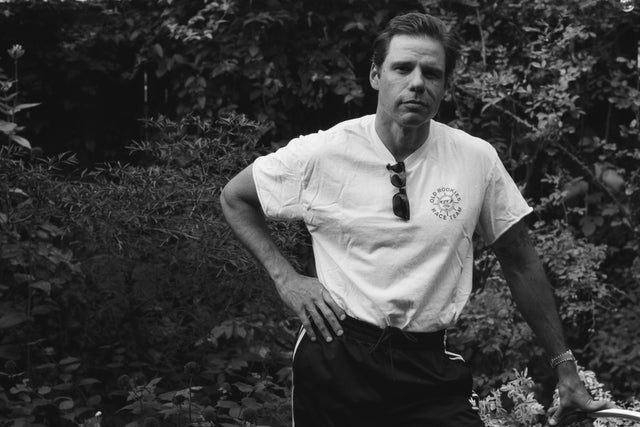
Afie Jurvanen does not spend too much time in cities these days. For nearly two decades, Jurvanen was a fixture of the Toronto scene, both as a valued multi-instrumentalist and producer for friends like Feist, The Weather Station, and Kathleen Edwards and as the architect of one of his country's most celebrated artists, Bahamas. Jurvanen came of age across Bahamas' first six albums, the restlessness of jumpy early hits like Pink Strat and Barchords slowly shifting into the generous domesticity of 2023's Bootcut. But Jurvanen has long been drawn to open spaces, to a quieter life. In 2009, the year of his aforementioned debut, he began visiting Nova Scotia, the Atlantic Ocean. Over the next decade, his trips became more consistent, then more frequent, and then longer, until, in 2019, Jurvanen and his family of four finally made the move--nearly 2,000 kilometers northeast, to Nova Scotia. They live a lifestyle, Jurvanen half-jokes, that is "close to Mennonite."
But in 2022, Jurvanen went back to a city--namely, Music City, or Nashville, Tenn. During five days at the Sound Emporium, he worked with some of America's true country greats, aces like Vince Gill and Sam Bush, Russ Pahl and Mickey Raphael. Bootcut. When Jurvanen came home, though, he still had a few tunes and plenty of energy. Could he make more music, he wondered, outside of a city?
In 2021, however, producer and multi-instrumentalist Joshua Van Tassel had also left Toronto, moving back to Nova Scotia and building a little studio, called DreamDate, in a backyard shed there. It was just small enough to skirt inspections, just big enough to house everything. Jurvanen had once rented Van Tassel's space back in Toronto to listen to his Earthtones album on someone else's speakers, to decide if it was ready for release. He'd been impressed by the place's minimalism and tidiness, by the studio rarity of everything working. So Jurvanen began driving the 20 minutes from his cottage to Van Tassel's spot via a winding ocean road, passing his days hanging out with his local friend and recording some songs. And that's how two people in a little shed made what may be the most effortlessly magnetic record in the entire Bahamas catalogue, My Second Last Album.
For a long time, Jurvanen didn't know what to do with My Second Last Album. After cutting a legitimate country record in the city where the genre lives, was it a too-weird left turn to put out a loose-limbed indie-pop set cut in a shed? But then he put the record back on after not hearing it for several months and had the simplest and most profound realization possible: He loved these songs, the story they told about who he was at that moment--a married father content to live in the country alongside the very ocean where he surfs, a musician who often goes to his buddy's house to casually make some music. It became My Second Last Album, one of Bahamas' truly indispensable works.