We're sorry, we're unable to process your request. Please try again.
|
To edit your Favorites or customize your e-mail preferences, go to My Ticketmaster.
By signing up, you may receive e-mails directly from the artist's representatives as well as from Ticketmaster.
If you are under 13 years old, you must not fill in this form or provide any information about yourself. Privacy Policy.
Do more, see more with My Ticketmaster.
Placeholder
Rock and Pop
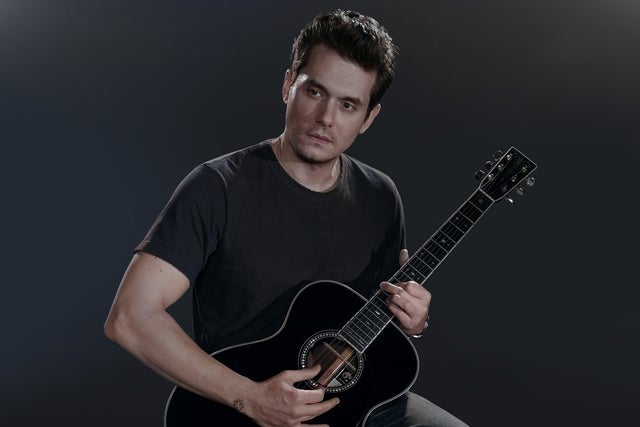
John Mayer Tickets
You're in the loop for John Mayer! We'll email you before tickets go on sale in your area.
Have more than just one favorite artist? Let My Ticketmaster keep track of all of them for you.
Has your taste changed? Use My Ticketmaster to find some new favorites!
Add to Favorites
End of Add to Favorites simulated dialog content.
John Mayer Tickets and Concert Dates
Biography
Short Biography
"With any trilogy," says John Mayer, "the third in the series blows it open."
On CONTINUUM the singer/songwriter/guitar slinger meets that challenge head-on. Mayer's third studio album follows the multi-platinum ROOM FOR SQUARES (2001) and HEAVIER THINGS (2003) and marks his first turn as producer. It is his most soulful, cohesive collection yet and he says it's no accident that this project is where all of his efforts, his potential, and his disparate influences fully come together.
"The night I was recognized for ‘Daughters' at the Grammys was the night this record started," he says. "I knew I had bought the time to learn everything I needed before I started this one. CONTI...
Short Biography
"With any trilogy," says John Mayer, "the third in the series blows it open."
On CONTINUUM the singer/songwriter/guitar slinger meets that challenge head-on. Mayer's third studio album follows the multi-platinum ROOM FOR SQUARES (2001) and HEAVIER THINGS (2003) and marks his first turn as producer. It is his most soulful, cohesive collection yet and he says it's no accident that this project is where all of his efforts, his potential, and his disparate influences fully come together.
"The night I was recognized for ‘Daughters' at the Grammys was the night this record started," he says. "I knew I had bought the time to learn everything I needed before I started this one. CONTINUUM is not a shot in the dark, it's not a guesstimation. This is the first endeavor in my entire life, music or otherwise, that I did not cop out for a second on."
The last few years have seen Mayer maintaining a frantic pace. In addition to his own writing, recording, and touring, he has collaborated with icons and contemporaries alike - Eric Clapton, B.B. King, Buddy Guy, and Herbie Hancock, as well as Kanye West, the Dixie Chicks, and Alicia Keys. In doing so, Mayer says his own interests have grown and his perspectives expanded.
Mayer also credits his collaboration with Steve Jordan and Pino Palladino (collectively known as the John Mayer Trio) and the intimate-venue tour that produced the 2005 live album TRY! with helping to recalibrate his musical priorities. "As a songwriter, the Trio helped me focus on being more raw," he says. "As a guitar player, it helped me get a lot out of my system. If it wasn't for the Trio, CONTINUUM would have been less accessible. It let me settle up with my needs as a musician, and get to a point somewhere between the Trio record and ROOM FOR SQUARES - and that's a really good place to be."
While the Trio tour showcased Mayer's blazing fretwork, he says he learned lessons from those shows about restraint. "When I made my first record, there was no trust in space because it was all me, everything was just on those six strings," he says. "With Steve and Pino, it was all about space, using a whole different palette. When your tone is good on the guitar you need, like, four notes. The more concise and right you have it, the less you need around it." One listen to such spare, carefully crafted songs as "Slow Dancing in a Burning Room" or "I Don't Trust Myself (With Loving You)" instantly reveals this new approach.
Mayer points to one song in particular as the turning point for CONTINUUM. "I wrote ‘Gravity' last summer, and it changed everything," he says. "You talk less when you trust that people understand you. ‘Gravity' had to be sparse. And when I listened to it - for the first time, holding back - then it was a whole new game. That might be the most important song I ever wrote."
Armed with this outlook, Mayer knew CONTINUUM would tackle larger ideas than those that defined his previous albums. "A big challenge was writing about big themes," he says. "I'm not a better writer in terms of sitting down in front of a pad, but I'm better in terms of receiving inspiration and converting it into something ‘real' quicker. I'm better equipped to deal with those moments."
The hard-hitting "Belief," tackles an infinitely complex subject. Over a slinky, hypnotic guitar groove, he sings "We're never gonna win the world, we're never gonna stop the war/We're never gonna beat this if belief is what we're fighting for," questioning the power and the limitations of faith and convictions. "It's an intellectual landmine - how do you write a song about what people believe without impugning their beliefs?," he asks. "I wanted to get right next to people's belief and look at it without threatening it. It's tricky. You only get x number of syllables and you have to write something you can defend."
(MORE)
With "Waiting on the World to Change, Mayer shot for something even more ambitious - something like an attempt to explain his generation's attitudes about politics. "It's meant to shed a little light on inactivity and inaction," he says, "because I don't believe that inaction is disinterest, I think inaction is preservation - nobody wants to get involved in a debate in which the rules and the facts will change so that they'll lose. So we end up with this other option, which is, I guess we'll just have to wait for things to get better.
CONTINUUM also includes the first cover Mayer has put on an album, his version of "Bold As Love" by the incomparable Jimi Hendrix. "To me, it's the quintessential Jimi Hendrix song," says Mayer. "The sensitivity, the imagery, the power. I also think the third record is the time when you challenge everybody. It's your throwdown. I like inviting the challenge of, should this guy even touch Hendrix's music? To which I answer, well, everybody should. Why not?"
Having just announced a co-headlining tour with Sheryl Crow to help launch CONTINUUM, Mayer is raring to start playing his new material for an audience. "This record is infinitely playable," he says. "I built so many corners into these songs I cannot wait to play them live - I've been imagining myself on stage playing ‘Slow Dancing in a Burning Room' for the last six months."
Ultimately, CONTINUUM represents maturity, both musically and thematically, for John Mayer - a concept that he wasn't comfortable with until now. "A lot of these songs are about coming to terms with getting older," he says. "My generation was never told we were going to get older. We thought we were going to hear our names on ‘Romper Room' for the rest of our lives. For a long time, I was really upset about getting older, worried that things were just going to level out.
"But then I realized that everyone around me was all getting older at the same time. We're all fighting it together, and we're always going to be those kids, the first really emotionally aware generation. When I realized that, I could relax about it a little bit. And I thought that maybe I can be the guy to sing about it."
null
In-depth Biography
After making his introduction as a sensitive, acoustic-styled songwriter on 2001's Room for Squares, John Mayer steadily widened his approach over the subsequent years, encompassing everything from blues-rock to adult contemporary in the process. Arriving during the tail end of teen pop's heyday, he crafted pop music for a more discerning audience, spiking his songcraft with jazz chords and literate turns of phrase. The combination proved to be quite popular, as Room for Squares went triple platinum before its follow-up release, Heavier Things, arrived in September 2003. Mayer continued to retool his sound with each album, however, moving beyond the material that had launched his career and adopting elements of rock, blues, and soul. Moreover, he partnered with legends of several genres, making guest appearances on albums by Buddy Guy, Eric Clapton, and B.B. King, while touring alongside jazz icon Herbie Hancock. Mayer also retained enough pop/rock foundation to continue his reign of the charts, making him one of the decade's most popular songwriters.
Born in Bridgeport, CT, and raised in the nearby town of Fairfield, Mayer began playing blues as a teenager. By 1997, his skill on the electric guitar was enough to warrant admission into the Berklee College of Music, although Mayer dropped out after two semesters to pursue a songwriting career in Atlanta. Working alongside former classmate Clay Cook, he frequented the local coffeehouse circuit and began co-writing material that melded palatable pop/rock with unexpected flourishes. Cook and Mayer parted ways shortly thereafter, however, with Cook joining the Marshall Tucker Band's touring lineup for several years. Now a solo artist by default, Mayer recorded several of the duo's songs, packaged them alongside a handful of his own compositions, and self-released the EP in 1999 under the title Inside Wants Out.
Mayer secured a deal with Aware Records in early 2000, and recording sessions for his debut album commenced later that year with producer John Alagia, renowned for his work with Dave Matthews and Ben Folds Five. Although Inside Wants Out had been a decidedly acoustic effort, Room for Squares proved to be a more expansive affair, with several of Mayer's old songs receiving new, radio-ready arrangements. Released in 2001 by both Aware and Columbia Records, the album quickly launched Mayer's career, with "No Such Thing" and "Your Body Is a Wonderland" both becoming Top 20 hits.
As Mayer hit the road in support of the album, his considerable talent as a lead guitarist (a skill that had been downplayed during Room for Squares) flourished, leading him to showcase several blues-influenced solos on his 2003 live album, Any Given Thursday. That same year, Mayer won his first Grammy Award for "Your Body Is a Wonderland." He returned to the Grammy ceremony two years later, this time to accept a pair of awards for "Daughters," a soulful ballad from his lucrative sophomore release, Heavier Things. Commercial and critical success notwithstanding, Mayer's interest in other genres convinced him to take a brief break from pop music, and he tested his instrumental chops by collaborating with blues artists (Buddy Guy, B.B. King, Eric Clapton) and jazz legends (John Scofield, Herbie Hancock). He also assembled the John Mayer Trio, whose bluesy rock & roll was displayed on the band's first and only release, Try!
Mayer returned to his solo career with 2006's Continuum, a warmly received album that saw him focusing on blues, pop, and contemporary soul. "Gravity" found modest success as a single, but "Waiting on the World to Change" proved to be the album's commercial highlight, cracking the Top 20 in February 2007 and winning a Grammy that same month. Later that year, Mayer achieved his highest-charting single to date with "Say," a song from the Rob Reiner film The Bucket List. After "Say" peaked at number 12, the song was included in a reissued version of Continuum, and it took home yet another Grammy Award (along with "Gravity") in early 2009. Following the release of a live album, Where the Light Is, Mayer once again returned to the studio in 2009, this time to record Battle Studies. ~ Andrew Leahey, Rovi
See Less