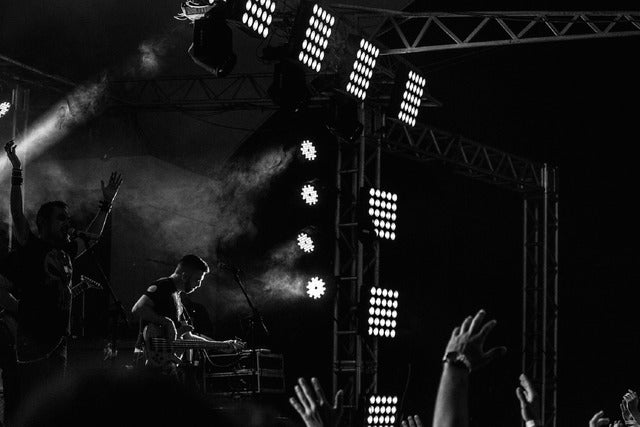
After nearly two decades of releasing album after album of critically acclaimed
music—but receiving surprisingly little mainstream response in the U.S.—Irish
band the Frames seem to finally be getting the attention they've long deserved.
Strange that the vehicle to get them there would have been a low-budget indie
film written and directed by ex-Frames member John Carney. The film,
Once, is a musical starring Frames frontman and songwriter Glen Hansard
and Czech singer/pianist Marketa Irglova, and the accolades it's received are
glowing—to say the least. "Close to perfect" says New York Times. "A
magical, beguiling wonder," declares Rolling Stone.
Glen and
Marketa are currently playing shows to support the Once Soundtrack as
well as their 2006 album The Swell Season, and the Frames are gearing up
to embark on a North American tour in August. Ticketmaster caught up with Glen
(and briefly with Marketa) via telephone to speak about the film, the tour, and
his approach to performing live.
American Frames fans have always
felt somewhat spoiled to be able to see you in smaller, intimate venues—but all
of that will probably change when Once gets its wide US release in
October and more Americans are exposed to your music. Do you have any
anticipation in regards to this?
Glen Hansard: Well I have to say
that I'm over the moon. I'd be an idiot to say, "F**k it, I don't care" because
it almost feels to me that the Frames have almost gone out and canvassed for
every single member of our audience so far, and it almost feels to me sometimes
that we know every single member of our audience. On this trip, for instance,
there's a really good fan of ours in Philadelphia, Emma, and she's like "This
f**king film! What is this going to do to you?" And I was like, "What do you
mean?" And she was like, "You'll be playing to Wachovia Center now in Philly and
we'll never get to see you again and I don't like this!" And I was like, this is
amazing! Fair play to her honesty, but on the other hand, I'm like, you know,
isn't this what we do it for and isn't this what you wanted? So it's a weird
double-edged sword. You have to just kind of embrace this and kind of enjoy it.
And to be honest with you, the past couple of weeks have been really, really
amazing for me. And it kind of feels like for seventeen years...it was kind of
like the Frames against the world. You're making your albums and you're putting
out your art and you're really into it. And then one day you make this little
film as part of you moving on and doing your thing...and one day the world just
turns around and goes "What?" You're kicking the world's ass for all that time
and it turns around and goes "What?"—and it's the most terrifying and
overwhelming and weird feeling. So that's what it's felt like. We landed in New
York four or five days ago, myself and Mara. We did an interview with I think it
was Sirius Radio, and we decided to walk back and within two blocks we got
stopped like twenty times saying "I really enjoyed your film. Thank you." And
the response we've been getting has been really genuine, which gives me a lot of
heart, I've gotta say.
I remember when I watched the film a couple
months ago, I couldn't help but overhear a couple talking next to me who were
amazed that you and Mara had not only "acted" in the movie, but were shocked to
find in the credits that you both wrote the songs as well. How do you react to
the fact that a lot of people's first impression might be that you're an "actor
who also writes music?"
GH: Well that's kind of strange for me. Yeah, it
is. But then again I guess in all the interviews we've done—and maybe people
don't read interviews—but certainly anything that we've put out there in the
world, the whole thing was that John had kind of discovered fairly late on...I
mean...Cillian (Murphy) was to play this role. And Cillian only pulled out like
two weeks before we start shooting and I was given, basically, a couple days to
decide. Because John had kind of thought about a couple other people. I'd
recommended Damien Rice for the role because Damien's younger than me and the
character in the film was meant to be a younger kind of guy. And John was like,
"No, Glen, I really want you to do it." So I only had a couple of days to think
about it because after that I was in. I was locked in to the job. And so...so...I
can't remember your question now, sorry!
Would it get your goat in any
way that people wouldn't know that, foremost, you're a musician?
GH: Not
really. I don't really care. Because the kind of people who would come and see
the film who'd say, "Oh look a couple of actors wrote music, let's check them
out...or let's not." It doesn't really matter to me. I guess, in a way, what
always really matters is that someone says, "Well, who are these guys?
What are they about?" And John came to the conclusion very quickly that he'd
rather have a couple of musicians who can half act than have a couple of actors
who can half sing. And that's been kind of the thing we've been saying across
the board and it makes a lot of sense to me. So, I don't know. If anyone does
their homework they'll realize that we're musicians and not
actors.
You seem to be a big fan of the cinema, having named the album
Fitzcarraldo after the Werner Herzog film and if I'm not mistaken, there
are maybe a few other cinematic allusions in your music?
GH: Ah, there's
plenty of ‘em!
So is film a medium you've always wanted to dabble
in?
GH: Well it's always something I've wanted to do as somebody who made
films. I mean, I do shoot a lot of stuff. I've got a 16mm camera and I do really
enjoy that idea. But I guess I'm more just a kind of lover of film. I was very
upset to hear today that Ingmar Bergman died. I was really, really sad. So I
guess I'd be a fan of film rather than somebody who would ever feel that I had a
place in it. But I have to say, John's original script for Once...was, you
know...it was pretty light. And that was the thing, once myself and Mara got on
board it was kind of like, "Ok John, you want us to do this film? Now you'd
better be f**king brave and you'd better make something that's real." And it
was almost a challenge. Let's make this film for nothing because if we use a
producer, it's not that making a film for money is bad, but if we use a producer
it means that we're in a situation where they're gonna have a say in what goes
on. And I really don't want anyone telling us what we should and shouldn't do
with this film...And also, that kiss scene at the end? It's gone!...They never
get it together because they can't!...So I guess my love of cinema definitely
helped with fighting John on a few points. Because what I think Once is,
for me anyway, is it's kind of a simple...it's almost like a Dardenne brothers
story but with music...
Have you been getting offered more film roles
as a result?
GH: (laughs) Yeah, I got offered a couple of
film roles, yeah. We're not doing them, but I got offered them and it was nice
to get offered. It's one of those things, you know, if someone like Herzog comes
along and says "I know you're a fan and I'd like to use you in something." Or,
you know, Jim Jarmusch...you know what I mean? Of course you'd do it! Of course
Mara would do it. But that hasn't happened (laughs).
So nothing
less is going to tempt you away.
GH: Well just the idea of getting
an agent here in L.A. or wherever right now...it's just a bit
surreal.
Alright, so let's talk now about music. You're currently on
your Swell Season tour, and the Frames start touring in August.
GH:
Yeah.
So when was the last Frames tour? I know you've been touring
solo for a while.
GH: We did a European tour about two or three months
ago and then we come back and did a US tour after that. (Speaking off the phone
to Marketa) When were we here last Mara? When were we last in America, the
Frames? (Pause) Yes it was in April and me and Mara now have kind of come back
and done this. And then we've been doing summer festivals. And even the night
before this we were in Belgium for a festival. So, like, the Frames has been
working pretty much nonstop up to now and I'll jump on a plane straight to New
Zealand after this, so we're busy, you know? And I guess I have to keep both of
them on the go. But it's quite difficult for me jumping from one to the other.
It's not as simple as just putting down the electric guitar and picking up the
acoustic. It is quite difficult because it's a different head space, you
know?
Definitely. I can imagine. So...Mara is there?
GH: Mara is
here, yeah. Do you want to say hello?
Sure!
GH: 'K, hang on.
Marketa Irglova: How are you?
I'm good, how are you
doing?
MI: Good, good.
I wasn't expecting to talk to you today,
so thanks so much for jumping on the phone. So...will you be making any guest
appearances on the Frames tour?
MI: No (laughs). That's a question
people have been asking me. They've kind of just expected me to be there with
the Frames in September. But no, I kind of have to explain to them that I've
never really played with the Frames. So no, I'm not going to be over in
September.
I ask because I'm sure this is something our readers would
be interested to know. But, too bad, then.
MI: Well...apologies.
(laughs)
It's alright. But you are playing live right
now. In fact you've got a show in LA coming up very soon.
MI: Yeah. We're
playing on Wednesday at the El Rey Theatre.
I saw you play at the
Troubadour last year with Glen, and also at Largo.
MI: Oh nice, nice. I
remember both those gigs.
I was front row center and you both sounded
amazing.
MI: Thank you.
Is it a bit more intimidating playing
in larger venues now for this tour?
MI: No, not at all. I mean, we've
just been really excited about the whole thing. It's just great walking onstage
in a venue full of people. The biggest gig we did was in Washington D.C. which
was 1200 people in the 930 club and it's just such an amazing feeling to walk
onstage and feel the energy of the room. So intimidating is not the word. If
anything, it's exciting and energizing and...and... (voices are heard in the
background.) Oh, we're just in the Jay Leno (The Tonight Show) studio...I
think we're on soon.
Oh, are you on soon? Ok! Well...thanks so much for
talking with me.
MI: No problem (laughs). I'll put you on to Glen.
GH: Hiya.
Hi. So I hear you're onstage pretty
soon?
GH: Yeah! It's cool, it's cool. I mean, we've played this song a
million times...
What song are you doing?
GH: It's
"Falling slowly." So it's not like we have to worry about it.
(laughs)
Alright, speaking of live performances, you encourage
a lot of interaction when you perform. Is it important for you to have the
audience dictate, in a way, the setlist and other elements of a gig?
GH:
Not really, no. I guess at one point in my life it was...but I guess more and more
I'm kind of getting more into the idea that...actually what audiences want
sometimes is that they want you to be the artist, you know. And sometimes I get
stick for it from my band who say (the audience) just wants you to do your thing
and they can just watch it. Rather than you interacting and you, basically,
letting them set the terms. So it's definitely a bit of both. I mean I do like
the idea of it but I think sometimes you have to...you've got to know when
to...uh...
Take the reigns.
GH: When to take the reigns, exactly,
and take control of what you're doing.
You've already released two
terrific live CDs (Setlist & Breadcrumb Trail) but are there
any hopes of you releasing a DVD?
GH: Well, we've got so much
footage now. It's all down to me. I keep blocking it because I keep looking at
it and going, "It's not good enough and people won't like it." So basically what
needs to happen is that it just needs to be taken away from me. I need someone
to kind of take it away from me and someone else just put it out and say,
"Glen...you don't have any say about this. We're doing it anyway."
I
see. Ok, let's make that happen.
GH: Yeah (laughs)...At this stage it
will almost be like a DVD which will span 20 years almost.
I know that
you are a big admirer of greats like Van Morrison, Leonard Cohen & Bob Dylan
whom you were fortunate enough to meet early on in your career. Do you think
it's important for established musicians to seek and help out emerging
musicians, and are there any up and coming artists that you're
championing?
GH: I don't think it's important to seek anybody out or to
help anybody out. I think it's important that you make your way in the world and
that you do your thing. And I think that if you're being true and if you're
good, you'll always find your way. Fionn Regan...he's an Irish guy who's just
released an album that has just floored me. I just think it's fantastic. He's on
tour right now in the States. If you get a chance to see him, you shouldn't miss
him.
What is it about him do you believe sets him apart?
GH:
I'm not really sure, you've just got to listen to those songs. He's got an album
called The End of History that's just come out. He's getting a little bit
of attention, but I really think you should take a listen to it. It's kind of
hard to explain what it is he's doing. It's kind of simple, but sometimes
something that's quite simple has such a great
impact.
Certainly. Well, I think we're up to our last
question which is our standard Ticketmaster question that we like to ask
artists. What's the most memorable concert that you've ever attended and
why?
GH: The most memorable concert I've ever attended was a Leonard
Cohen concert when I was 15. I went to see Leonard Cohen with my cousin who was
like five years older than me. He had recently been hit by a stolen car in
Dublin, and he was having epileptic fits after. And during "Famous Blue
Raincoat" at the gig, my cousin went into a fit, and Leonard stopped the gig and
basically said, "Is this kid alright?" He was doing a matinee and an evening
show, and we went off to the Hospital and they made sure we got tickets to the
evening show. And we came back and Leonard come up and shook our hands and said
"Are you ok?" to my cousin. And as a 15-year-old singer/songwriter, that was the
most profoundly important moment.
That's an incredible
story.
GH: Yeah, so that will always stand out as the gig, for me.nullnullnullnull