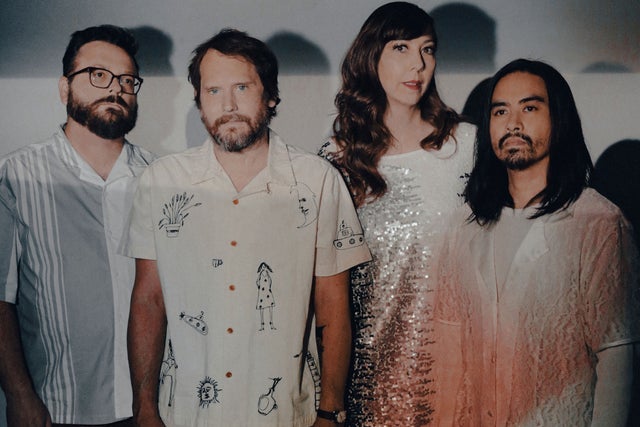
One of Los Angeles' most treasured new bands, the Silversun Pickups are soon to become a national favorite with the release of their full-length debut, Carnavas. The album delivers on the promise of the alt-rock quartet's earlier EP, Pikul, and its large, fuzzy sound is sure to please fans of the group's stellar live shows. Ticketmaster recently spoke with frontman Brian Aubert about the new album and the band's current tour in support of the release.
Ticketmaster: You're in the middle of a U.S. tour right now. Have there been any highlights so far?
Brian Aubert: Every time I think the highlight has happened, the next show proves that it didn't. There's just constantly being highlights. We're just stunned. The most stunning thing is we've holed ourselves up in making this record, even though we were turning on the EP a bunch but mostly on the West Coast, and to have worked as hard as we have on the record, and then to do this and immediately come out and start playing these places that we have hardly played or we never have played...Like in Minneapolis. Let's use that as an example. I've never been there before. And to play the show that we played with the crowd the way they were and the response, it's just crazy. People are coming up to us and going, "Oh, my God. You sold out D.C., New York, Chicago and Minneapolis." And that's cool, but, man, it's not the selling out part. It's that people are going crazy, like singing songs and just stuff like that. It's just constantly a surprise. Minneapolis, let's say, has been a highlight. And we're super excited we sold out Buckhead Theatre and the Troubadour (club in Los Angeles). We're amazed...they're some of my favorite venues.
TM: Have you noticed any differences between L.A. audiences and other audiences across the States?
BA: There are little differences. Obviously, you get into the big cities and the people are a little bit more calm. But not too much. If you play smaller towns, people go extra crazy. But so far our shows have been pretty much amazing. L.A. and New York always get credited with these reay bad crowds, and I understand and I see it. They've seen things and there are industry people who really don't care. But I think we've been lucky in L.A. because we've been playing there for so long that people that come to see it really like it. So we never really have bad crowds.
TM: What's your musical background? When did you first become interested in music?
BA: I've always really been into it. I've always liked music. I started playing guitar when I was seven just for fun. It's just something I've always sort of liked. And I think it skips a generation. My father is real scientific and a total mathematician. And his dad was a total musician guy...So my kid will be a football player. (laughs)
TM: But your grandchildren...
BA: But my grandchildren are gonna rock! (laughs)
TM: How did you get together with the other members of the band?
BA: I met Nikki on a plane when I moved to England. She was stealing alcohol bottles out of the stewardess's thing and I thought that was really cool. We became friends...Then I started to want to do my own music after being in a friend's band for a while. Nikki was one of my roommates and she wanted to learn how to play bass, so she came down and started plunking on the bass. And our other roommate came down with some drums, and we were just kind of messing around in the studio. And then they sent a tape to CMJ (a music festival in New York) because they thought it would be fun to see what would happen. A boombox in the middle of the room and there weren't even any songs or anything. And we got into the festival.
TM: Wow. That's cool.
BA: Yeah, tell me about it. I don't even know if we could (get into the festival) now, but we did then. And that's how if first started. Then once we played in New York we didn't really have any songs and I would never sing or anything. And this guy Mitchell Frank who runs Spaceland saw us in New York walking down the street and he said, "Hey, why don't you guys play L.A. when you come back?" So we started playing Spaceland and all these places and we've been playing ever since pretty much. And everything has just sort of evolved from that time. Everything evolved while playing. Nothing really happened in the practice space beforehand. Everything was always happening at shows. And that's sort of how it happened for us.
TM: How would you describe the music scene in Los Angeles? Is it supportive? Competitive?
BA: I'm sure it's both, you know...when we leave L.A., people try to pinpoint it all the time, like what it is. And they're always right and they're always wrong. It's just a huge, huge city which is what I think makes it unique. It's still like a complete metropolis. It just doesn't look like one. There are so many people there. So besides the billion people trying to get into the entertainment industry, there are also a billion plumbers and people born and raised there. With the people that we sort of stick with on our side of it all, we don't really see too much of that competitiveness and all that kind of funk. We see that sometimes, but the people that we are friends with and that we play shows with, everyone's in it the same way. Everyone's real supportive. I'd almost say it's super supportive.
TM: Let's talk about the new album Carnavas. How does it compare with your EP Pikul?
BA: Well, the EP was basically a collection of stuff that we self-released, including a song or two that we recorded specifically for the EP. It was just going to be a holdover for us to make the record. We basically just documented what we were doing. We didn't have much time in the studio. We had like two days to make a bunch of songs. So we just go in there and play like we play live and record it and there it was, you know. And the EP kind of grew legs, which was crazy. We thought in L.A. for sure people would be into it, but outside of L.A. is what we tripped out on. Because of certain radio stations like KEXP in Seattle and WOXY in Cincinnati and a bunch of online stuff, it grew some legs. And that made us go out and tour for the EP more, and the EP really started to exist further than we thought. And it was great because that gave us time while we were touring to really think about the record. The EP had a certain aesthetic in the way it sounded, and we wanted the record to be a whole different thing. Not in the way where we're all of a sudden a ska band. But we just wanted the record to have a different sound. The EP was very warm and kind of acoustic-y a little, and we wanted the record to sound kind of metallic and shiny. It was the first time we actually got to go into the studio for a while and just focus on making a record. So we got real meticulous with sounds. We got producer Dave Cooley and this engineer Tom Biller who works with Jon Brion all the time, so that guy's a genius. And we just got really into the technical aspects of it and instead of just going in there and documenting what we were doing, we thought about songs and sounds and shapes and how it all went together and made one sort of full thing. And the irony kind of being that it sounds more like us live than our EP does. With the EP we played live and recorded it and it sounds warm. But the record is really thought out with a lot of work behind it...and all that work made it sound more like we do live than the EP. We were kind of hitting a ceiling before, because live we like it really, really loud and really crazy. We like it to be very big sounding. And the record, with all its work, I think we achieved that.
TM: Do you prefer recording new material in the studio or playing for audiences live?
BA: Playing for audiences, straight on. That's just what it's all about really. We know people that just love to record and don't really like to play live, and I think that's just crazy. Recording is fun in a different way. It's a lot of work and you kind of lose your mind. But live is just really gratifying. It's really fun. That's how we started. We were a live band for a while in L.A. That's what we like to do, and we weren't even thinking about other things. And I think that's how the band will always be.
TM: How do you approach your live shows?
BA: We really approach them the way we always have. Playing things exactly like they sound on the album or the EP, that sounds okay, but they just don't quite punch in like we'd like it to. So we kind of get it to be a little more reckless and play things a little bit quicker. A little bit more energy and stuff like that. That's how we do it. It's fun in L.A. too...again, we didn't move there to start something. We were just there and L.A. happened to be our backyard and there are all these great clubs. It was fun because people sort of knew who we were and we were able to do things...In certain towns that had never seen us before, especially before our record came out and when people didn't know our material, we would just kind of focus on the louder songs. Just get in there and make a big noise. What's cool about Los Angeles for us—just cool about anybody's hometown—is that we can do that sometimes but we can also play shows at Tangier or something where we play acoustic and make things really strange and play all of these other songs that we wouldn't necessarily play in front of new audiences...It's fun.
TM: Can you take us through the typical songwriting process for the band?
BA: Here's basically how it goes. It's almost always this way, but sometimes it may change. I start out with a song pretty much. And I come in with a blueprinted way that it can change and all this other stuff with melodies. So I've kind of written the song, but I didn't really. I just bring it in like that, instead of bringing in an idea and you just jam it out ‘cause we don't really like to jam. (Jamming) is kind of boring and stupid things happen for us. I come in with a blueprint with things like that and the other guys, the three of them, attack it and tell me why I suck and how to make it better. Then they take it and form it and the whole thing kind of comes together. So it either changes completely or stays the same. But everybody adds their stuff on it and gives input. And that's pretty much exactly how it goes. I'll start the ball rolling, but they make the ball big.
TM: Some fans have praised you for bringing back a ‘90s alternative rock sound. How would you respond to that?
BA: It was not a mission statement or anything like that. I think more with Carnavas we've gotten that response and I can see it too, especially since Carnavas is our rock record. We didn't get that very much with the EP but we definitely get that with this. I think it's cool. I mean, people have to compare it to something. That seems the way it always goes and we've actually learned a lot about bands from who people have said we're influenced by. We're like, "Oh, we've never heard of those guys, but we'll listen to them." Obviously, we knew who My Bloody Valentine were and we knew who the Smashing Pumpkins were...We knew who those guys were, but it wasn't necessarily stuff we were listening to. That's just kind of how it sounds. We like the big warm guitar sounds and stuff like that. So I think it's cool. And the bands that people compare us to seem to be really good bands. And we're kind of like, "Wow, really? You think we're like them? Wow. Thanks!" People always go, "Are you offended?" But it's like, "Why? No, it's great." But it was never our thing to bring some sort of thing back, and we've been playing the way we've been playing for a long time in Los Angeles, and that never really came up until lately now that we're a little bit out there and the record sort of sounds like that. But I can see it and I think it's cool. I just did an interview and the guy was like, "Did you make it your statement to bring back the shoegaze movement?" And I was like, "What? No, but if you want, yeah, sure." We're pioneering the ways of the past (laughs)...People usually come up to you and say you sound like this, and they're kind of pulling from their pool of what they like. Unless they hate you and they don't talk about you at all.
TM: So who are some of your musical influences?
BA: We listen to all kinds of music. Usually, it's like Neu! and Can and Neil Young. Lately it's been Tom Petty like mad...We were hugely active in going out to see bands all the time in eastern Los Angeles, like in Silverlake and Echo Park and all those places. There are just so many clubs and so many different kinds of bands happening all the time. We were constantly out. If we weren't playing, we were out watching bands and seeing new bands. I would say we were almost influenced by a lot of the bands from Los Angeles, like The Movies, 400 Blows or Autolux. The Secret Machines, before they signed with Warner Bros., they used to stay with us all the time and we'd see them play and go, "Man, look at that!" Friends' bands pretty much. Sea Wolf is just killing it right now. Bands like that. They kind of influenced us and not necessarily in a sonic way...In Los Angeles, we're just so proud of how much great music is happening. There's just so much going on.
null